By Andrew Tan
The real reasons production data pipelines break in the middle of the night — and the engineering practices that prevent it
The pager goes off
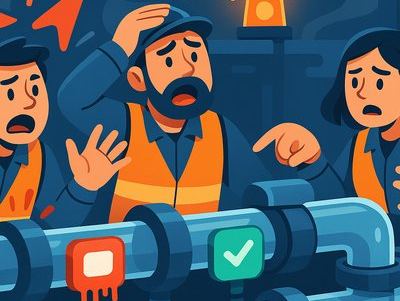
It's 3:17 AM. Your phone vibrates off the nightstand. You fumble for it, squint at the brightness, and see the same message you've seen before: "Data pipeline failed. Last successful run: 14 hours ago."
You know what happens next. You'll spend the next two hours in Slack threads, looking at logs that don't make sense, trying to figure out if this is the same failure from last week or something new. By 6 AM, you'll have a workaround running. By 9 AM, you'll tell your team it's "handled for now." And by next month, you'll do it all again.
I've been there. More times than I care to admit. And after years of building data infrastructure and talking to teams who've been through the same cycle, I've noticed something: the 3 AM failures aren't random. They follow patterns. And most of them are preventable.
Why 3 AM specifically?
There's nothing magical about the hour. But there is something predictable about the conditions that exist at 3 AM:
The human factor is at its lowest. The engineers who built the pipeline are asleep. The operators who know the quirks are off-shift. The institutional knowledge that lives in someone's head isn't accessible. You're left with documentation that was accurate six months ago and a runbook that skips the steps that "everyone knows."
The data volume often peaks. Global user bases mean that "night" in your timezone is "day" somewhere else. That 3 AM failure? It's probably happening when your Asian or European users are most active. The pipeline that handled 10,000 events per minute at noon is suddenly drowning in 50,000.
Dependencies fail in cascading chains. Your pipeline doesn't exist in isolation. It pulls from databases that run their own maintenance windows. It writes to APIs that have rate limits. It depends on services that deploy updates during off-peak hours. When one link breaks at 3 AM, the ripple effects hit your pipeline before anyone's awake to notice.
Batch jobs stack up. That 2 AM ETL job runs fine until the day it doesn't. Maybe the source system was slower. Maybe the data volume was higher. Maybe a network hiccup added 20 minutes of latency. Suddenly your 2 AM job is still running at 3 AM, and the 3 AM job — the one your dashboard depends on — starts anyway, creating a race condition that corrupts half your data.
The 3 AM failure isn't a single bug. It's the intersection of multiple design decisions that were fine in isolation but catastrophic together.
The five patterns that cause most night failures
After watching dozens of teams debug these incidents, I've identified five recurring patterns:
1. The silent failure
The job reports "success" but produced garbage data. No alerts fired because the pipeline didn't crash — it just silently did the wrong thing. You don't find out until someone in the morning asks why yesterday's revenue numbers look like a phone number.
Why it happens at night: Daytime failures get caught by humans who look at dashboards and notice anomalies. Nighttime failures wait until morning.
The fix: Validation gates. Every pipeline should have explicit data quality checks that fail the job if outputs don't meet expectations. Row counts within expected ranges. Null rates below thresholds. Referential integrity checks. If the data is wrong, the pipeline should fail loudly, not succeed quietly.
2. The resource starvation
Your pipeline worked fine in staging. It worked fine for months in production. Then one day, the data volume hit a threshold you didn't know existed, and suddenly you're out of memory, out of disk, or out of API quota.
Why it happens at night: Many resource limits are soft until they're not. Memory leaks accumulate. Log files grow. Temp tables fill up. The 3 AM job is the one that finally hits the wall.
The fix: Resource monitoring with proactive limits. Don't just monitor whether the job finished — monitor memory usage trends, disk space trajectories, API quota consumption. Set alerts at 70% thresholds, not 100%. And design for graceful degradation: if you can't process everything, can you process the most important subset?
3. The external dependency timeout
Your pipeline calls an API. Usually it responds in 200ms. Tonight it's taking 30 seconds. Your default timeout is 60 seconds, so the job doesn't fail immediately — it just slows to a crawl. By the time it times out, it's holding locks on resources that other jobs need.
Why it happens at night: Third-party services do maintenance during off-peak hours. Network paths get rerouted. DNS propagates. The infrastructure you don't control changes without warning.
The fix: Circuit breakers and timeouts tuned to reality. If 99% of API calls complete in under 5 seconds, set your timeout to 10 seconds, not 60. Implement circuit breakers that fail fast when a dependency is struggling. Design retry logic with exponential backoff, not immediate retries that hammer a struggling service.
4. The state mismatch
Your pipeline processes events in order. But tonight, events arrived out of order. Or duplicate events arrived. Or events arrived with timestamps that don't make sense relative to each other. Your stateful aggregation produced nonsense because the assumptions about event ordering were violated.
Why it happens at night: Distributed systems are eventually consistent. Network partitions happen. Message queues reorder under load. The invariants you assumed — "events arrive in order," "events arrive exactly once" — are guarantees your infrastructure doesn't actually provide.
The fix: Defensive state management. Use event-time processing, not processing-time. Handle out-of-order events with watermarks. Design for at-least-once semantics and make your aggregations idempotent. Assume events will be late, duplicated, or missing — and handle it gracefully.
5. The configuration drift
The pipeline worked yesterday. Nothing changed in the code. But someone updated an environment variable. Or rotated a credential. Or changed a database schema without updating the pipeline. The code is the same, but the world it runs in shifted.
Why it happens at night: Infrastructure changes often deploy during maintenance windows. Schema migrations run at off-peak hours. Credential rotations happen on schedules. The 3 AM job is the first to encounter the new world.
The fix: Configuration as code, tested like code. Every environment variable, every secret reference, every schema assumption should be version-controlled and validated. Run pipelines in a "dry run" mode after infrastructure changes. Alert on schema drift. Treat configuration changes with the same rigor as code changes.

The mindset shift: from "handle failures" to "prevent them"
Most data teams I know operate in reactive mode. The pipeline fails. They fix it. They document what happened. They move on. Then it fails again, for a slightly different reason, and the cycle repeats.
The teams that don't get paged at 3 AM have a different approach. They think in terms of failure domains and blast radius. They ask: "If this component fails, what else breaks?" They design for graceful degradation rather than perfect reliability.
Here's what that looks like in practice:
Test failures, not just success paths. Your test suite should include scenarios where dependencies time out, data is malformed, and resources are exhausted. If you only test the happy path, you're not testing production.
Observability over monitoring. Monitoring tells you that a job failed. Observability tells you why. Invest in tracing that follows events through your pipeline. Log context, not just events. Build dashboards that show the health of data quality, not just job completion.
Chaos engineering for data pipelines. If you haven't deliberately broken your pipeline in a controlled way, you don't know how it fails. Run drills where you kill database connections, introduce latency, and corrupt input data. Learn your failure modes before they learn you.
On-call that escalates to people who can fix it. The person who gets paged at 3 AM should be someone who can actually fix the problem, not just restart the job and hope. If your on-call rotation is too junior, you're just delaying the real fix until morning anyway.

Building pipelines that sleep through the night
Resilient data pipelines share common traits. They're not magic — they're engineered with specific patterns:
Idempotency everywhere. Running the same job twice should produce the same result as running it once. This makes retries safe and recovery automatic.
Backpressure handling. When downstream systems can't keep up, the pipeline should slow down, not crash or drop data. It should shed load gracefully, not catastrophically.
Bounded state. Stateful operations should have limits. Windowed aggregations with TTL. State stores with eviction policies. Don't let unbounded state become an unbounded problem.
Explicit contracts. Define and validate schemas at pipeline boundaries. Reject malformed data early. Fail fast when assumptions are violated.
Operational runbooks that work. Every alert should have a runbook. Every runbook should be tested. If the runbook says "check the logs," specify which logs, what to look for, and what to do when you find it.
The bottom line
The 3 AM pager doesn't have to be inevitable. It's a symptom of design choices that prioritized throughput over resilience, completion over correctness, and feature velocity over operational maturity.
The teams that sleep through the night aren't luckier. They've invested in the unglamorous work of error handling, validation, and observability. They've accepted that failures will happen and designed systems that handle them gracefully.
Your users don't care if your pipeline was clever. They care if the data is right when they need it. Build for that.
What's next
If you're tired of 3 AM pages, start with one change: add a single validation gate to your most critical pipeline. Check row counts. Verify null rates. Validate a key business metric. Make the pipeline fail if the data looks wrong.
It's not a complete solution, but it's a start. And once you've felt the relief of catching a data quality issue before it reaches your users, you'll be motivated to add the next safeguard.
For data engineering teams building streaming pipelines, layline.io provides built-in backpressure handling, exactly-once semantics, and visual debugging that makes it easier to understand what's happening when things go wrong — whether that's at 3 PM or 3 AM. The Community Edition is free to explore.

Andrew Tan is a serial entrepreneur and founder of layline.io, building enterprise data processing infrastructure that handles both batch and real-time workloads at scale.